
A Liquor Primary licence is intended for businesses where liquor service is the primary focus, such as bars, pubs, lounges, nightclubs, and some entertainment venues. The application process involves both the Liquor and Cannabis Regulation Branch (LCRB) and the applicable local government or Indigenous Nation, with each authority playing an important role in reviewing the proposed business.
This guide summarizes the typical Liquor Primary licence application process, from establishing your business entity and preparing floor plans through municipal review and community consultation, Approval in Principle (AIP), final inspection, and licence issuance.
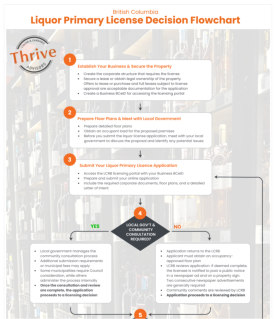
Liquor Primary license decision flowchart
Step 1: Establish your business & secure the property
- Create the corporate structure that will require the liquor licence
- Secure a lease or obtain legal ownership of the property.
Offers to lease or purchase and full leases subject to license approval are acceptable documentation for the application - Create a Business BCeID for the accessing online liquor licensing portal
Proceed to Step 2.
Step 2: Prepare floor plans & meet with local government
- Prepare detailed floor plans showing the proposed licensed areas
- Obtain an occupant load for the proposed premises
- Before you submit the BC liquor license application, meet with your local government to discuss the proposal and identify any potential issues
Depending on the municipality, additional approvals may be required before the application can proceed.
Common examples include:
- Development Permit
- Rezoning
- Land Use approval
- Building Permit
- Other municipal planning requirements
Early discussions with local government can help identify potential issues before significant time and money are invested.
Proceed to Step 3.
Step 3: Submit your Liquor Primary license application
- Access the LCRB licensing portal with your Business BCeID
- Prepare and submit your online application
- Include the required corporate documents, floor plans, and a detailed Letter of Intent describing your proposed operation
Working with an experienced BC liquor licence consultant can help ensure your application is complete and accurate, reducing the risk of delays caused by incomplete documentation or avoidable application errors.
Once submitted, your application becomes available to the applicable local government or Indigenous Nation through the licensing portal.
Proceed to Step 4.
Step 4: Does the local government conduct the community consultation?
Yes
- The local government manages the community consultation process
- Additional submission requirements or municipal fees may apply
- Some municipalities require Council consideration, while others administer the process internally
- Once the consultation and review are complete, the application proceeds to a licensing decision
No
- The application returns to the LCRB
- The applicant must obtain an occupancy-approved floor plan
- LCRB reviews application. If deemed complete, the licensee is notified to post a public notice in a newspaper ad and on a property sign. Two consecutive newspaper advertisements are generally required
- Community comments are then reviewed by the LCRB
- Once the consultation and review are complete, the application proceeds to a licensing decision
Proceed to Step 5.
Step 5: Was your application approved?
Yes
The application may be approved outright or approved with requested amendments, such as reduced operating hours, changes to occupant load, additional noise mitigation requirements, or others.
No – Refused
Contact the LCRB to determine why the application was refused. Depending on the reason, you may be able to amend the application or address the issues and submit a new application.
Step 6: Approval in principle & construction
- Once approved, the LCRB issues an Approval in Principle (AIP) letter
- The AIP authorizes construction or renovations to begin
- The AIP is generally valid for one year
- Complete construction within the approval period
- When construction is complete, request your final LCRB inspection
Typical timelines range from approximately 8 to 12 months from the start of the application process until the Approval in Principle letter is issued, although processing times vary depending on the project and municipality.
Proceed to Step 7.
Step 7: Final inspection & licence issuance
- Complete the final inspection with the LCRB
- Once approved, the Liquor Primary licence is issued
- Receive the approved final floor plan
- Obtain any required municipal business licence
- Order liquor inventory and prepare to open
Resources
The following Liquor and Cannabis Regulation Branch (LCRB) resources provide additional information about Liquor Primary licences.
Let Thrive help with Liquor Primary licensing
Applying for a Liquor Primary licence involves coordinating corporate documentation, municipal approvals, community consultation, LCRB requirements, and final inspections. Missing a required document or overlooking a municipal requirement can significantly delay the licensing process and increase start-up costs.
Thrive Liquor & Cannabis Advisors assists bars, pubs, lounges, breweries, entertainment venues, and hospitality businesses throughout British Columbia with Liquor Primary licence applications, licence amendments, regulatory compliance, and ongoing licensing support.
If you’re looking for trusted advisors who work in partnership with you to ensure the success of your business, let’s talk.
Sign up for a 30-min complimentary discovery session.
Let’s start the conversation.