
A Liquor Manufacturer license allows wineries, breweries and distilleries in British Columbia to manufacture authorized liquor products. Manufacturer licenses are also available to co-packers that bottle, blend or flavour liquor on behalf of licensed manufacturers.
For wineries, breweries and distilleries, the basic license also permits sampling, guided tours and product promotion. Additional endorsements are required for certain activities, including on-site retail sales, lounge service, special events and picnic areas.
This guide outlines the Liquor Manufacturer license application process from choosing the appropriate manufacturing operation through Approval in Principle, final inspection and license issuance.
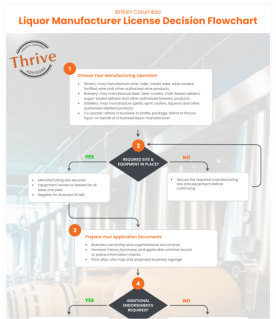
Liquor Manufacturer license decision flowchart
Step 1: What type of manufacturing operation are you applying for?
Identify the manufacturing operation that best matches the business you plan to operate.
Winery
A winery may manufacture wine, cider, mead, sake, wine coolers, fortified wine and other authorized wine products.
Brewery
A brewery may manufacture beer, beer coolers, malt-based seltzers, sugar-based seltzers and other authorized brewery products.
Distillery
A distillery may manufacture spirits, spirit coolers, liqueurs and other authorized distilled products.
Co-packer
A Manufacturer license for co-packing activities allows a business to bottle, package, blend or flavour liquor on behalf of a licensed winery, brewery or distillery. The liquor remains the property of the licensed manufacturer and must be returned to the manufacturer when the co-packing work is complete.
Co-packing does not authorize fermentation, distilling, direct liquor sales, patron sampling or manufacturer endorsements.
Proceed to Step 2.
Step 2: Do you have the required manufacturing site and equipment?
Wineries, breweries and distilleries must have the equipment necessary to manufacture liquor on-site. Production equipment may be owned or leased. If it is leased, you must have at least a one-year lease.
Once licensed, manufacturers must maintain the required equipment and continue manufacturing liquor to keep the license active.
Yes
You have identified an appropriate manufacturing site and have arranged the equipment required for your proposed operation.
Before applying, you should also have:
- A Canada Revenue Agency business number
- A Business BCeID
- Access to the Liquor and Cannabis Licensing Portal
No
Secure an appropriate manufacturing site and arrange the equipment required for your proposed operation.
If you will be leasing production equipment, make sure the lease meets the minimum one-year requirement.
Return to Step 2 once these requirements have been addressed.
Step 3: Prepare your application documents
Prepare the documents and plans required for your Liquor Manufacturer license application. Requirements vary depending on your proposed manufacturing operation and business structure (sole proprietorship, private corporation, partnership, public corporation, society or non-profit corporation).
Your application will generally require:
- Business ownership and organizational documents required for your applicant type
- Personal History Summary forms and any applicable criminal record or police information checks
- A scaled floor plan of the proposed manufacturing facility
- A site map showing the manufacturing site and relevant surrounding features
- Proposed business signage, including the name and logo
Make sure your plans accurately reflect the proposed manufacturing facility, equipment and any sampling or retail areas included in the application.
Proceed to Step 4.
Step 4: Do you need any additional endorsements?
Wineries, breweries and distilleries can apply for endorsements that permit additional activities such as on-site retail sales, lounge service, special events or picnic areas.
For more information about these options, see our BC liquor license endorsements guide.
Note: Manufacturer licenses for co-packing activities are not eligible for endorsements.
Yes
Determine which endorsement or endorsements are appropriate for your operation and prepare the required supporting information and approvals.
No
No additional endorsement application is required.
Proceed to Step 5.
Step 5: Submit your Liquor Manufacturer license application
Access the Liquor and Cannabis Licensing Portal and log in using the Business BCeID you set up in Step 2, then:
- Submit your completed Liquor Manufacturer license application with the required documents, plans and application fee
- Include any endorsement applications and supporting information that form part of your proposed operation
- Make sure all required documents are submitted and the application fee is paid so the application can be assigned for review
- Consider working with Thrive Liquor & Cannabis Advisors - experienced BC liquor license consultants - to help ensure your application is complete and accurate and reduce the risk of delays caused by missing documentation or avoidable application errors
Step 6: Did you receive Approval in Principle?
The LCRB reviews the application and, if the applicant and proposed manufacturing operation meet the applicable requirements, issues Approval in Principle (AIP).
The Liquor Distribution Branch is also notified of the AIP and works with the applicant to establish the Manufacturer's Agreement required for the sale and distribution of liquor. Manufacturers must comply with this agreement as a condition of their license.
Yes
Once Approval in Principle has been issued:
- Complete any required construction or site preparation
- Install the required manufacturing equipment
- Contact your local liquor inspector when the facility is complete and you are ready to begin manufacturing
No
Review any outstanding requirements identified by the LCRB.
Additional documents, information or revisions may be required before Approval in Principle can be issued.
Once the outstanding requirements have been addressed, return to Step 5.
Step 7: Final inspection and license issuance
When construction is complete, the required manufacturing equipment is in place and you are ready to begin manufacturing:
- Contact your local LCRB liquor inspector to arrange the final inspection
- Make sure the required federal excise license is in place before the inspection
- Complete the final inspection with the LCRB
- Once approved, pay the applicable prorated first-year annual license fee
- Receive your Liquor Manufacturer license
- Complete any remaining LDB requirements and begin operating in accordance with the terms and conditions of your license
Note: Liquor Manufacturer licenses and applicable endorsements must subsequently be renewed annually.
Proceed to Step 8.
Step 8: Sign and return your LDB Sales Agreement
Following Approval in Principle, the Liquor Distribution Branch (LDB) provides a Sales Agreement for review and signature. This agreement establishes the requirements that allow the manufacturer to register products and sell them in British Columbia.
- Review and sign the Sales Agreement provided by the LDB
- Return the signed agreement to the LDB
- Once your license is issued, complete the required product and SKU registration before selling your products in BC
Proceed to Step 9.
Step 9: Apply for your Federal Excise License
Liquor manufacturers must also meet applicable federal excise requirements administered by the Canada Revenue Agency (CRA). The specific licence or registration required depends on the type of manufacturing operation.
- Apply to the CRA for the excise licence or registration required for your manufacturing operation
- Complete the applicable federal excise requirements before beginning production
Resources
The following resources provide additional information about Liquor Manufacturer licensing in British Columbia:
Liquor Manufacturer licensing help from Thrive
Applying for a Liquor Manufacturer license involves coordinating business documentation, manufacturing equipment, facility plans, LCRB requirements, potential endorsements, the LDB Manufacturer's Agreement and the final inspection. Missing information or overlooking a licensing requirement can delay the application and increase start-up costs.
Thrive Liquor & Cannabis Advisors assists wineries, breweries, distilleries and other liquor manufacturing businesses throughout British Columbia with liquor license applications, endorsements, license amendments and ongoing regulatory compliance.
If you’re looking for trusted advisors who work in partnership with you to ensure the success of your business, let’s talk.
Sign up for a 30-min complimentary discovery session.
Let’s start the conversation.